Last updated: June 2026
Quick answer: To get a Texas learner's permit, be at least 15, complete the first part of a TDLR-approved driver ed course (classroom can start at 14), then bring your DE-964 certificate, ID, proof of residency, VOE, and DL-14 application to a DPS office and pay $16. There's no written test at DPS — it's in your course.
What a Texas Learner's Permit Is (and What It Lets You Do)
A Texas learner's permit — DPS officially calls it a learner license — lets you practice driving on real roads while a licensed adult age 21 or older sits in the front passenger seat. It's the first stage of the Texas Graduated Driver License program: permit first, then a provisional license after you turn 16 and pass the road test, then a full unrestricted license at 18.
You cannot drive alone with a permit — not to school, not around the block, not ever. What you can do is log every one of the 44 required practice hours with your parent or another licensed adult beside you, which is exactly what the permit is for.
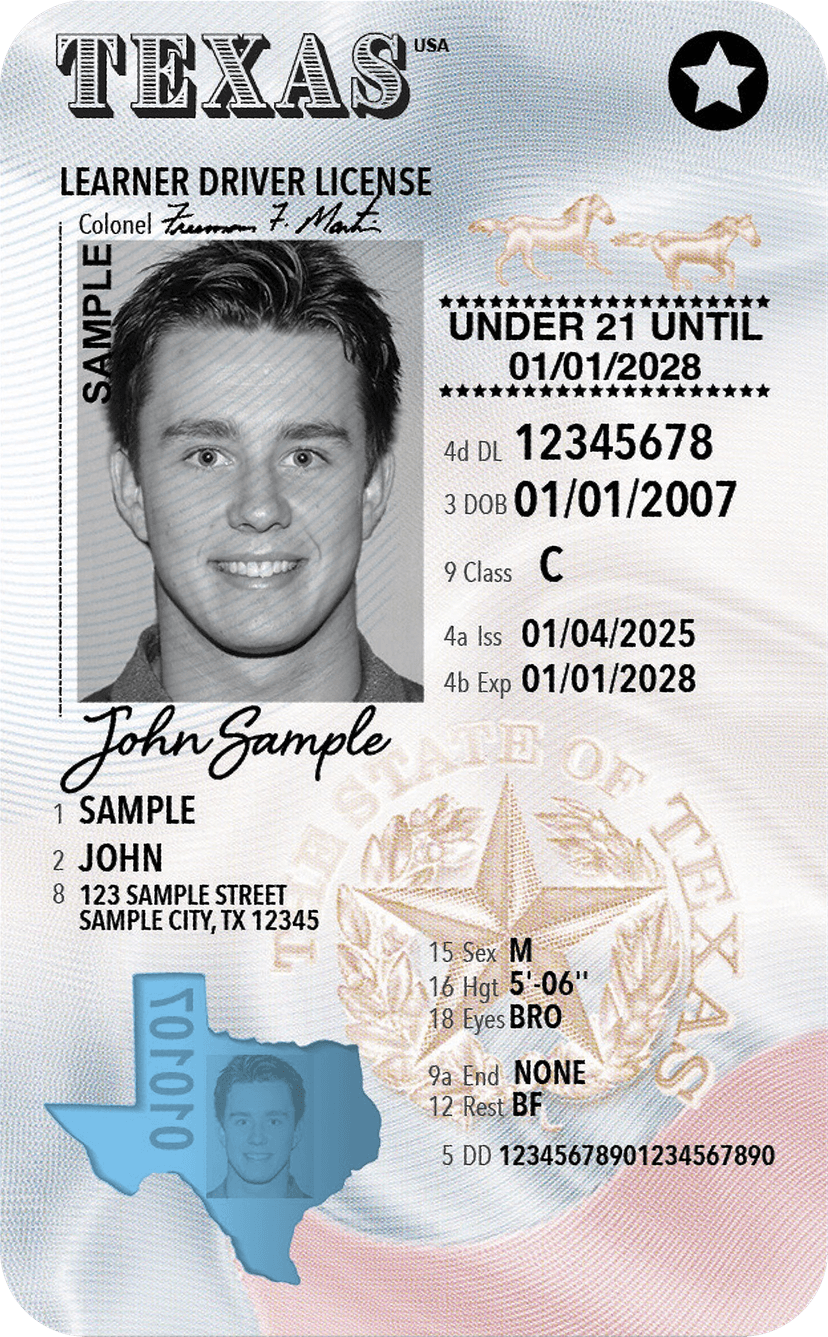
For most teens, getting here is a three-part process: complete the first 6 hours of a TDLR-approved driver ed course online (the first lesson of the 24-hour course), receive your DE-964 certificate the moment you pass the in-course exam, and take it to DPS with the rest of your documents.
Can you get your learner's permit online in Texas? No. The driver ed course is online, but the permit itself requires an in-person DPS visit — that's where the document check, vision test, and photo happen. No online service can issue the permit for you.
Just moved to Texas with a permit from another state? The rules are different for you — start with our out-of-state permit transfer guide.
Texas Learner's Permit Requirements by Age
The process changes depending on how old you are. Find your age below, or use our free license eligibility checker to see exactly where you stand.
At 14: You Can Start Driver Ed (But Not Get the Permit)
No, you can't get a learner's permit at 14 in Texas — but you can start the classroom portion of driver education. Many students begin the course at 14, finish the first module and exam at their own pace, and walk into DPS shortly after their 15th birthday with everything ready. If your family has a documented hardship that requires you to drive before 16, Texas offers a separate hardship license (MRDL) with its own rules.
At 15: Full Eligibility (the Most Common Age)
At 15 you can get the permit as soon as you've completed the first part of a TDLR-approved driver ed course — parent-taught (PTDE) or a driving school both count. Your parent or legal guardian must come with you to the DPS appointment and bring their own valid ID. From there you'll hold the permit at least 6 months and finish the rest of the course before the road test.
At 16–17: Same Process, Less Waiting Room
The steps are identical to starting at 15 — driver ed course, DE-964, DPS visit. Graduated license rules still apply: you must hold the permit for 6 months, complete all 44 behind-the-wheel hours, and finish the ITTD course before taking the road test. Since you're already 16+, the 6-month hold is usually the only clock you're waiting on. If you're within a year of turning 18, read the expiration callout below before you plan your timeline.
At 18+: The Permit Is Optional
Yes, you can get your license at 18 without ever holding a permit in Texas. Adults aren't required to have a learner's permit — though many get one anyway so they can practice legally before the driving test. Here's what applies instead:
- Ages 18–24: you must still complete a driver education course before getting a license — the 6-hour adult driver ed course qualifies.
- Age 25 and older: no course is required, but you take the knowledge test and the driving test.
- Impact course: adults may complete either ITAD (1 hour) or ITTD (2 hours) before the driving test — either one satisfies the requirement.
Step 1: Finish the First Part of Driver Ed (and Skip the DPS Written Test)
Texas requires 24 hours of classroom instruction for teen drivers (reduced from 32 hours in December 2024) — but you don't need all 24 before the permit. You become permit-eligible after the first 6-hour module and the in-course knowledge exam. Most families use this concurrent approach: get the permit early, then finish the remaining lessons while practicing behind the wheel.
The exam is 30 questions, and you need 70% to pass. Because the test is built into the course, students enrolled in driver ed take no written test at DPS — your DE-964 certificate is the proof you passed. Want a head start? Warm up with our free permit practice test.
Any TDLR-approved course works — a parent taught drivers ed course like ours or a commercial driving school. The permit steps at DPS are the same either way.
Step 2: Gather Your Documents (DPS Checklist)
What do you need to bring to get your permit? DPS is strict about documentation — if anything is missing or in the wrong format, they'll turn you away and you'll have to rebook. Run through this list the night before, or print our interactive DPS checklist and check items off as you pack them.
Required documents
- DE-964 certificate — printed correctly (see above). Don't sign it until DPS tells you to. Your course provider makes it available after you pass the in-course written test.
- PTDE receipt number — the 452PT... number from when your parent ordered the TDLR packet. Parent-taught students only.
- DL-14A or DL-14B form — fill it out at home but leave the signature lines blank. Use DL-14A if you're 17 years 10 months or older; DL-14B if you're younger. Our DL-14B form guide walks through it section by section.
- Proof of identity — original birth certificate (state-issued, not hospital) or a valid U.S. passport. Photocopies are not accepted.
- Social Security number — DPS verifies your SSN electronically. Bring your Social Security card, W-2, or SSA-1099 as backup. The name must match your identity document exactly.
- Two proofs of Texas residency — each from a different source, dated within the last 90 days: utility bill, bank statement, school enrollment records, insurance statement. Your parent's documents work if you live at the same address.
- VOE form (Verification of Enrollment) — required if you're under 18 and don't have a high school diploma or GED. Get it from your school's registrar or counselor.
- Your parent or legal guardian with valid ID — required for all applicants under 18, present for the entire visit. If your designated parent instructor is not your parent or legal guardian, both must attend, and bring the Instructor Designation Form.
- $16 application fee — cash, check, or card.
Step 3: Book Your DPS Appointment ("Apply for First Time Texas DL/Permit")
On the official scheduler at public.txdpsscheduler.com, choose "Apply for first time Texas DL/Permit" as the service type. That one option covers learner permits — there is no separate "learner permit" service type, which trips up a lot of families mid-booking. If you're applying for your first permit, "Apply for first time Texas DL/Permit" is the right choice.
Appointments can book out 2–4 weeks at popular locations, so schedule early. Two tips that save weeks: check the scheduler early in the morning — DPS releases same-day slots each day and as cancellations occur, so you can often grab a slot for that day. And try multiple offices: smaller DPS locations outside major cities usually have much earlier availability.
Can You Take the Road Test at the Same Appointment?
No. The first-time permit appointment is document review only — there's no driving involved. The road test comes much later: after you've held the permit for 6 months, turned 16, completed your course and 44 practice hours, and finished ITTD. Booking a road test before you're eligible just wastes the slot.
Schedule DPS AppointmentStep 4: What Happens at the DPS Office
How long does it take to get your permit at DPS? Plan on 30–60 minutes once you're checked in, depending on how busy the office is. Arrive about 15 minutes early with your documents organized. Here's the visit, start to finish:
- Check-in — present your appointment confirmation and documents at the front desk.
- Document review — a DPS employee verifies your paperwork and enters your information. Missing documents get caught here.
- Vision test — a quick eye exam (minimum 20/40 vision). Bring your glasses or contacts if you wear them.
- Photo and thumbprint — your photo is taken for the permit card.
- Pay the $16 fee — cash, check, or card.
- Receive your temporary permit — you leave with a paper permit that's valid immediately for supervised practice. The hard card arrives by mail in 2–3 weeks.
That paper permit means you can practice on the drive home — with your parent in the front seat, of course.
How Much a Texas Learner's Permit Costs
The permit itself costs $16 — that's the only fee DPS charges. The real cost of getting permit-ready is the driver education that comes before it. Here's the full picture for the parent-taught route:
| Item | Cost | Notes |
|---|---|---|
| DPS application fee | $16 | Paid at the DPS office — cash, check, or card |
| Driver ed course | $60 | Our TDLR-approved course — one payment, both certificates included |
| TDLR PTDE packet | $20 | Parent-taught students only, ordered from TDLR |
| Written knowledge test | $0 | Included in the course — no separate DPS test fee |
| Total (parent-taught route) | $96 | Course + packet + DPS fee |
For comparison, commercial driving school programs in Texas typically run $350–500 for the same state requirements. See our pricing and the course comparison for the full breakdown.
Texas Learner's Permit Rules
Your permit lets you drive, with restrictions. These are state laws — violating them can mean a ticket or a delayed license.
- Supervised at all times — a licensed adult age 21 or older must be in the front passenger seat whenever you drive. No exceptions.
- No cell phone use at all — not even hands-free. The only exception is calling 911 in an emergency.
- PTDE instruction hours are restricted — behind-the-wheel instruction sessions with your parent instructor may only run between 5:00 AM and 11:00 PM.
- 6-month minimum hold — counted from the date DPS issues the permit. You can't take the road test before it's up.
- Valid until your 18th birthday — the permit doesn't expire after a set number of years; it lasts until you turn 18 or upgrade to a provisional license.
- Carry it — have your permit with you whenever you drive, and show it if law enforcement asks.
Can You Drive Alone (or to School) With a Permit?
No — never. A learner's permit does not allow solo driving for any reason, including driving to school, work, or an emergency. The licensed adult in the front seat is required on every single trip. If you're caught driving alone, you risk a ticket and delays to your provisional license. The one path to limited solo driving before 16 is the hardship license, which is a separate application with strict eligibility.
What Parent-Taught (PTDE) Students Do Differently
If you're doing parent-taught driver ed, the DPS process above is almost identical — with three differences worth knowing:
- Bring the PTDE receipt number — the 452PT number from the TDLR packet order. Driving school students don't need this; you do.
- Instructor Designation Form — if your designated instructor isn't your parent or legal guardian, bring the form and both adults to the appointment.
- Your written test is already done — you took it in the course, and your DE-964 was generated the moment you passed. No retesting at DPS.
Finish the first lesson, pass the exam, and the DE-964 is waiting in your dashboard.
Not enrolled yet? The course is $60 once — all 24 classroom hours, the in-course DPS exam, both DE-964 certificates, and the digital driving log. Rated 4.8/5 across 7,954 reviews.
Start the $60 CourseAfter You Get Your Permit
The permit is the milestone that makes practice legal — here's everything between you and your license:
- Finish your driver ed course — complete the remaining lessons (24 classroom hours total).
- Log 44 behind-the-wheel hours — 7 hours of instruction, 7 hours of observation, and 30 hours of practice including 10 at night. Our free driving hours tracker keeps the math straight.
- Hold the permit 6 months — from the DPS issuance date. Use the time to build real experience.
- Complete ITTD — the free Impact Texas Teen Drivers course. The certificate expires in 90 days, so take it close to your road test date.
- Pass the road test — once you're 16+ and everything above is done, schedule your driving test and trade the permit for a provisional license.